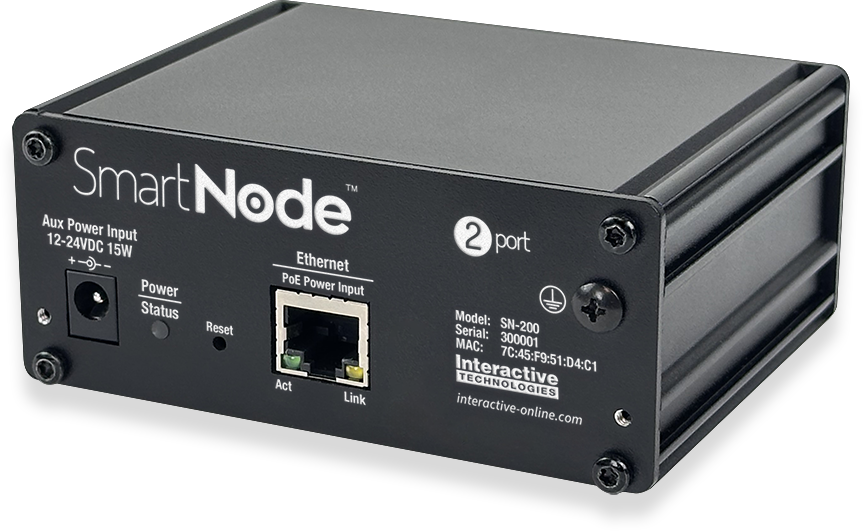
2-Port SmartNode
Welcome to SmartNode.
SmartNode is a flexible network I/O device that speaks many industry-standard control protocols and is easily customized to connect to a wide variety of external devices using Smart Modules.
Smart Modules are available with physical interfaces for DMX-512, Digital I/O, Dry Contact Relays, Station Bus, MIDI, and more. By combining SmartNodes with Smart Modules and configuring various input and output protocols, the user can create a wide variety of data distribution and control networks.

SmartNode is designed to excel in Entertainment and Architectural lighting control applications with its ability to distribute DMX-512 signals throughout a facility, as well as also manage button station networks, various analog and digital I/O ports, serial communications, and more.
Additionally, SmartNode operates using many open-standard protocols, which allows for a wide variety of other devices and custom-built solutions to utilize SmartNode as a full-featured network interface for DMX, Digital I/O, Serial, and all of the other physical interfaces offered by Smart Modules.
Usage Examples
SmartNode is highly customizable with a wide variety of available Smart Modules, and the various communication protocols that each can support. Here are just a few examples of what type of I/O scenarios that can be built with SmartNode:
Example 1: DMX Data Distribution
In a project using DMX for lighting control, several SmartNode devices can be distributed throughout the facility. Each node can have a combination of DMX Input and/or DMX Output modules configured to send and receive DMX data via the popular sACN (Streaming ACN) protocol. Data can be routed from the DMX Input port of one node to the DMX Output ports of other nodes. Alternatively, sACN data originating from a console or controller (such as CueServer) can be distributed to various DMX Output ports.
Alternate protocols can be used, such as Art-Net, or KiNET (Color Kinetics) protocols as well. Each port can be configured to merge sources, handle universe priorities, use fallback sources, or split data across multiple ports as needed to make more complex control scenarios.
Example 2: Button Station Networking
In a project using CueStation button stations with a CueServer processor, SmartNode can be fitted with a Station Bus module to provide the CueStation control network for connecting to the physical stations. Each CueStation module can be connected to several stations as needed.
Example 3: Auxiliary I/O
In a project needing specialized I/O, such as serial ports, contact-closure inputs, digital outputs, or dry-contact relays, SmartNode can be used with Digital I/O, Serial, and Relay modules.
A contact-closure input on one SmartNode can operate a relay output on another SmartNode through the network. UDP commands can be used to turn on and off digital outputs. Or a custom written application can monitor the voltages of analog inputs.